Thursday, December 11, 2008

State GOP: No Birthright Citizenship to kids of Undocumented Immigrants

State GOP: No automatic citizenship for kids born in U.S. to illegal immigrants

[http://seattletimes.nwsource.com/html/politics/2004450665_gop01m.html]

By Andrew Garber

Seattle Times staff reporter

SPOKANE — The state Republican Party adopted a platform Saturday that includes a provision aimed at opposing automatic citizenship for babies born in the U.S. to illegal immigrants.

The state party approved a similar platform plank at its 2006 convention that proved controversial. The 14th Amendment to the U.S. Constitution recognizes citizenship for all persons born in the United States.

"Immigration is an issue that a lot of our party activists feel strongly about," state Republican Party Chairman Luke Esser said. "And it's certainly a very defensible position. It's not at all something that's based on race concerns. It's a matter of what is citizenship going to be based on."

State Attorney General Rob McKenna, one of the state's most prominent Republicans, said he doesn't support banning automatic citizenship for children born to illegal immigrants.

We have more than 200 years of history in which children born in the U.S. are deemed U.S. citizens," said McKenna, before reading the platform language. "What matters is where the children are born."

Not all delegates attending the convention support the position, either.

"The Constitution says that if you're born in the United States you're a U.S. citizen," said Scott Workman, of Sequim. "I'm not willing to change the Constitution. If we're going to let them in and they're going to have babies here, then they're U.S. citizens."

The plank containing the provision was adopted without discussion. It's part of a much broader party platform approved at the state GOP convention Saturday stating positions on issues ranging from national defense to health care and education.

The plank covering immigration and homeland security says, "We welcome those who wish to build a new and better life in America and Washington state and to recognize that the only price of such opportunity is their willingness to embrace our language, culture and legal system, beginning at our national borders."

The provision goes on to say that legal immigration "can best be facilitated by a transparent, traceable and enforceable guest-worker program that does not include amnesty or birthright citizenship and sanctuary cities."

Mathew Manweller, chairman of the platform committee, said the language in the provision is intended to oppose automatic citizenship for children born to illegal immigrants.

"We have no problem with them becoming citizens if they go through [the legal process] but not simply by virtue of birth," Manweller said.

Esser said the issue of birthright citizenship is broader than just illegal immigration. For example, he said, "I think if you ask the average person, 'Should a couple vacationing in the United States who are citizens of another country have a child on U.S. soil, should that child be a U.S. citizen?', that doesn't sound reasonable."

Esser noted that prohibiting citizenship for the children of illegal immigrants could "require a change in the U.S. Supreme Court interpretation of the 14th Amendment, so, obviously, if that's the case it will be difficult to ever accomplish."

McKenna said he doubts the citizenship provision of the party platform will have much impact.

"I think the attention span of the public on party platforms is very brief. I don't think platforms help you or hurt you very much," he said. "Voters look at the candidates."

Also at the convention, the state GOP assigned its 40 delegates to the national convention, with presumptive nominee John McCain ending up with the bulk of them. The state party's delegates are awarded through a complex system of caucuses and primaries.

Although there was a strong showing by Ron Paul supporters at the convention, McCain received a total of 33 delegates, Paul got four and Mike Huckabee three.

Andrew Garber: 360-943-9882 or agarber@seattletimes.com

Public History Projects II: Online Archival Material

In addition to physical image and document collections, there are also archives found online that range from labor history to visual art movements in Washington’s Chicana/o and Latina/o community. One such source is the Chicano/Latino Archive hosted by The Evergreen State College Library. This research and teaching collection focuses on Chicano and Latino art in the Pacific Northwest, activity mostly during the 1970s and 1980s which ran parallel to literary and performance art movements and helped incorporate visual arts as a tool for expressing the goals of the Chicana/o Movement. Included in the archive is a guide to the original “Chicano/Latino Artists in the Pacific Northwest” exhibit (1984-86), an article from the UW-produced “Metamorfosis” journal on the state of the art movement, and an exhibit catalog, among others.

Another archive in Western Washington south of Seattle are the Columbia River Basin Ethnic History Archives at Washington State University, Vancouver Campus. The project itself is done in collaboration with the Idaho, Oregon and Washington State Historical Societies, as well as with the WSU-Pullman. The project focus is to highlight the presence of the oft ignored ethnic minority groups in the tri-state Columbia River Basin region (Western and Southwestern Idaho, Northern Oregon, Southern and South-Central Washington).

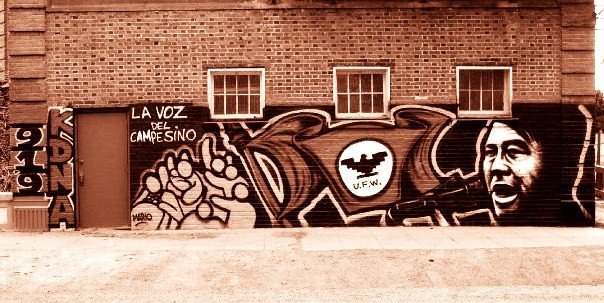
The University of Washington also houses two research units associated with Harry Bridges Center for Labor Studies. Created in 2004, the United Farm Workers in Washington State History Project documents the formation and evolution of farm labor history in the Yakima Valley from the late 1960s to the present (the unit is also undergoing an expansion). Of note are transcripts of interviews, a photo essay history of the UFW as seen through images donated by long time labor activist, Tomas Villanueva, as well as a page with external links to sites of interest.

The other of these two archives is the Seattle Civil Rights & Labor History Project. Within the archive is the “Chicana/o Movement in Washington State History Project” which was initiated in 2005 with the aid of a group of undergraduate researchers connected to MEChA de UW. The section includes a history timeline, a collection of oral histories, a page containing photo collections donated, a slide show, a historical narrative, a list of digitized newspaper articles and a special documents collection from MEChA de UW’s archive.

The last archive listed is the An Oral History Of The Crewport Farm Labor Camp project produced for the Center for Columbia River History, a unit produced in collaboration between Washington State University and Yakima Valley Community College. The Crewport archive includes a historical narrative created by then YVCC Professor, Mario C. Compean, a list of oral history interviews, a photo essay as well as a set of documents.

In addition to the aforementioned archives, yet another valuable resource is Dr. Jose Alamillo's Chicanos in the Northwest Project. Alamillo, formerly an Associate Professor in Comparative Ethnic Studies at Washington State University-Pullman, produced a brief narrative on Chicanos in the Northwest and published it on his own website. He also provides a bibliographic list of sources relevant to the regional study of Chicanos and Latinos in the Northwest.

Chicano/Latino Archive. <http://www.evergreen.edu/library/chicanolatino/>. The Evergreen State College. Accessed 11/15/08.

Columbia River Basin Ethnic History Archives. <http://www.vancouver.wsu.edu/crbeha/>. Washington State University, Vancouver Campus. Accessed 11/15/08.

Seattle Civil Rights and Labor History Project. <http://depts.washington.edu/civilr/index.htm>. University of Washington. Accessed 11/15/08.

United Farm Workers in Washington State Project, <http://depts.washington.edu/pcls/ufw>. Accessed 11/15/08.

An Oral History Of The Crewport Farm Labor Camp, Center for Columbia River History, <http://ccrh.org/comm/crewport/index.html> Yakima Valley Community College and Washington State University, Accessed 11/15/08.

Chicanos in the Northwest Project, Washington State University, Accessed 11/15/08


After a prolonged absence, due to a multiplicity of different things ranging from work, writing, and dealing with personal loss, I've decided to come back and update this blog. Granted, a lot has transpired since October of 2007, but I figure this will at least keep me busy. Here's to a new start in a new city.